When choosing bespoke electric gates for your property, every detail matters. From the precision of the automation system to the craftsmanship of the design, each element contributes to the gate’s overall quality, longevity, and aesthetic appeal. One of the most important decisions in this process is the choice of material. For customers seeking exceptional durability, refined beauty, and long-term value, wooden gates have emerged as a clear favourite.
At Windlesham Gates, we specialise in creating luxury electric wooden driveway gates that are not only visually impressive but also built to perform flawlessly for decades. Among the range of timbers we work with, Accoya wood consistently stands out as the most advanced and reliable material available for luxury gates.
In this article, we’ll explore why Accoya has become the premium option for electric wooden gates, and why it’s a material we proudly recommend to our clients who expect nothing less than excellence.
What Is Accoya Wood?
Accoya is a “modified” timber that has undergone a chemical process known as acetylation. This treatment transforms the wood’s internal structure so that it behaves more like high‑performance hardwood. Unlike superficial treatments or coatings, the modification penetrates the full cross‑section of the wood, making the properties consistent throughout.
Because of its modification, Accoya exhibits much greater dimensional stability (less swelling, shrinking, warping) than other timber, as well as resistance to rot, insect attack and decay.
How It’s Made (Acetylation Process)
Here’s a simplified breakdown of how Accoya wood is produced:
- The raw wood is kiln dried.
- The dried wood is exposed to acetic anhydride, which reacts with the free hydroxyl groups in the wood’s cell walls.
- This chemical reaction reduces the wood’s ability to absorb water (by converting those reactive sites into acetyl groups).
- After reaction, the wood is rinsed, dried and finished.
The upshot: the wood is less able to take up moisture, swelling and shrinkage are significantly reduced, and natural decay becomes far less likely.
Because the modification is non‑toxic and stable, Accoya is safe for use in contact with people, plants or animals — it doesn’t leach harmful chemicals.
Sustainability Credentials
Accoya is well regarded in sustainability circles. Key credentials include:
- It is made from sustainably managed, fast‑growing forests, with FSC or PEFC certification.
- The process is non‑toxic, and the material can be recycled at end of life.
- Over its lifecycle, Accoya may achieve carbon-negative status, because the carbon stored in the wood outweighs the energy inputs in manufacturing.
- It holds prestigious certifications such as Cradle to Cradle (Gold or Platinum) underlining its environmental credentials.
In short, Accoya combines high performance with ecological responsibility—something that aligns with Windlesham Gates’ commitment to quality and sustainability.
Why Use Accoya for Bespoke Electric Gates?
Weather Resistance: Warping, Rot & Insect Attack
One of the biggest challenges for electric wooden gates, especially those exposed to the UK climate, is maintaining structural integrity over time. Rain, frost, sun, wind all conspire to make timber warp, crack, swell or rot.
Because of its acetylation, Accoya resists decay, fungal growth and insect damage far better than untreated timber. Its dimensional stability means it is far less likely to warp or twist, even under changing humidity and temperature.
In an electric gate, where precision alignment is vital (so that the motor, hinges and latches work smoothly), stability is not just aesthetic — it’s functional.
Low Maintenance Requirements
For many clients, the appeal of an electric wooden gate lies in the charm of wood—but they dread constant upkeep. Accoya dramatically reduces that burden. Because its structure is modified, coatings (paints, stains) last longer, and issues such as blistering or peeling are much rarer.
In practice, an Accoya gate may only need light cleaning, occasional inspections, and a touch-up every few years—not the full re-sanding and refinishing regimen that lesser timbers require.
Longevity vs Traditional Timbers
Accoya offers industry-leading warranties of 50 years for above-ground use and 25 years for ground contact or freshwater use. Real-world experiments suggests Accoya gates can comfortably surpass those lifespans when well built and maintained.
By contrast, untreated softwoods may last only a fraction of that in our climate, and even many hardwoods suffer from dimensional changes, decay or maintenance overhead.
When you consider the lifetime cost of repainting, repairing, or replacing less stable timber, Accoya often becomes the more economical choice over decades.
Accoya Wood vs Oak or Softwood: A Comparison
Below is a comparative overview:
Feature | Accoya | Oak | Untreated Softwood |
Durability/decay resistance | ★★★★★ | ★★★★ | ★★ |
Dimensional stability | Very high | Moderate | Low–moderate |
Maintenance frequency | Very low | Medium | High |
Coating longevity | Long | Medium | Short |
Eco credentials | ★★★★★ | Moderate | Low |
Cost (initial) | High | High | Low–medium |
Oak is a traditional, premium hardwood, and it has good strength and natural durability. However, it will still swell, shrink and crack under moisture cycles, and coatings often degrade faster. While untreated softwood is the lowest cost, its longevity is poor in exposed settings; it often requires frequent treatment or replacement.
Thus, Accoya sits in a class of its own: combining the strength and aesthetics expected of hardwood with the stability, durability and low maintenance of a high‑performance modified timber.
Accoya Wooden Gates in Action
Case Study: Recent Windlesham Installation
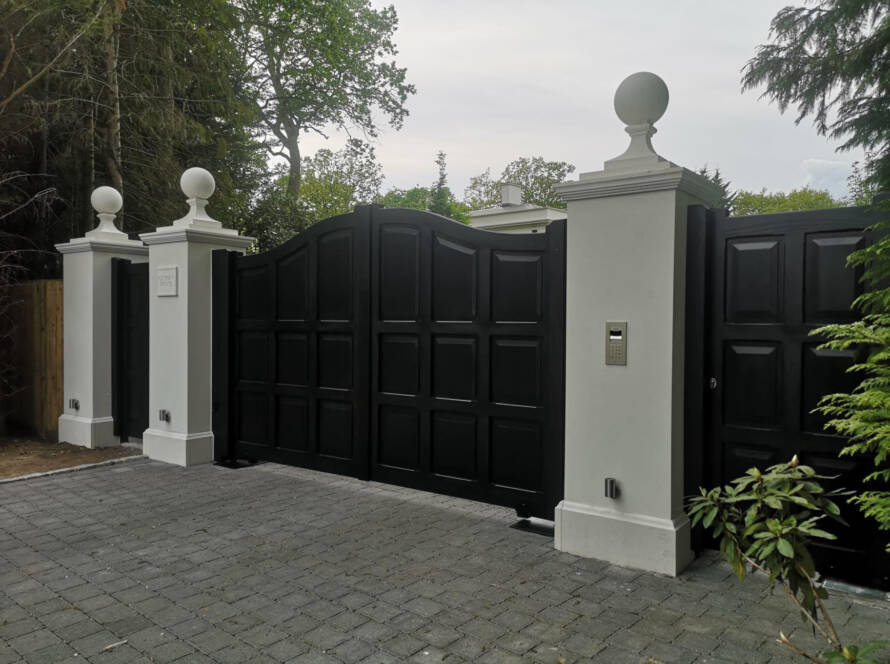
One of our recent projects (in Surrey) demonstrates precisely why we favour Accoya for bespoke gates. The brief was: large double swing gates of span ~4m, height ~2.2m, with decorative inlay details, to be automated and operate reliably through all seasons.
We specified structural framing in Accoya, using robust mortise-and-tenon joints, and applied a high-performance exterior coating system. The site was exposed to westerly winds and driving rain — a perfect test.
Client feedback after 12 months: the gates closed smoothly, alignment remained perfect, and only minimal cleaning has been needed. No cracks, warps or obvious wear to the finish have developed.
How Much Do Accoya Wooden Gates Cost?
Price Range for Supply and Installation
To give a rough guide (as of 2025):
- A pair of swing Accoya electric wooden gates (typical driveway, ~4 m span, 2.0–2.2 m height) might cost £10,000 – £18,000 (materials + automation + civil works).
- A single swing gate or sliding Accoya driveway gate might be in the range £7,000 – £14,000 depending on size and site conditions.
- Smaller bespoke designs, decorative inlays, or additional features (house name, lighting) will push the higher end.
These figures are indicative and will vary regionally, depending on complexity, ground works, access and finishing quality.
Factors Affecting the Cost
Several variables can materially influence the final price:
- Gate size & span: larger gates require heavier framing and automation.
- Design complexity: curves, inlays, cutouts, decorative metalwork all add fabrication time.
- Thickness/structural spec: heavy-duty framing, reinforcement, thicker boards cost more.
- Finishing system: premium coatings, multiple coats, special colours or stains raise cost.
- Automation & hardware: motor strength, safety sensors, intercoms, remote controls.
- Civil works & foundations: brick piers, concrete pads, power runs, trenching.
- Access & site challenges: difficult access or ground leveling adds labour overhead.
Value for Money (Lifetime Cost)
Even though an Accoya wooden gate is more expensive to build than one in untreated softwood, over 20–30 years the lower ongoing maintenance, less frequent repainting and lower repair/replacement cost typically mean its cost-per-year is very competitive—or even lower—than a cheaper gate that fails prematurely.
FAQs
Q: Is Accoya worth the cost?
A: Yes — especially if you value longevity, minimal maintenance and premium aesthetics. The upfront premium is compensated by decades of reliable performance with less fuss.
Q: How long do Accoya wooden gates last?
A: With proper manufacture and coatings, 50 years (above ground) is within warranty. Many installations last much longer. In practice, 40–60+ years is realistic in UK conditions.
Q: Can you paint or stain Accoya?
A: Absolutely. Accoya accepts paints, stains and high-quality coatings extremely well. In many cases, coating systems last far longer than on untreated wood. For best results, use exterior-grade products and follow coating manufacturer guidance.
Q: Can Accoya be repaired if damaged?
A: Minor surface damage (scratches, dents) can often be sanded and refinished. Structural damage (rare) may require component replacement, but stability helps prevent such damage in the first place.
Q: Does Accoya perform in extreme climates or coastal locations?
A: Yes — Accoya has been tested in exposed conditions, including maritime environments. The acetylation process ensures moisture fluctuations have a far smaller effect, making it suitable for challenging settings.
Invest in Excellence with Accoya Wooden Gates
Accoya wood has redefined what’s possible for luxury wooden gates. Its exceptional durability, stability, and sustainability make it the perfect material for electric wooden driveway gates. When combined with the craftsmanship and technical precision of Windlesham Gates, it results in truly premium bespoke electric gates that enhance your property’s security, functionality, and kerb appeal for decades to come.
If you’re considering Accoya wooden gates for your home, we invite you to contact our team to discuss your project. From the first design sketch to final installation, we’ll guide you through every step, ensuring your gates are every bit as exceptional as the property they protect.